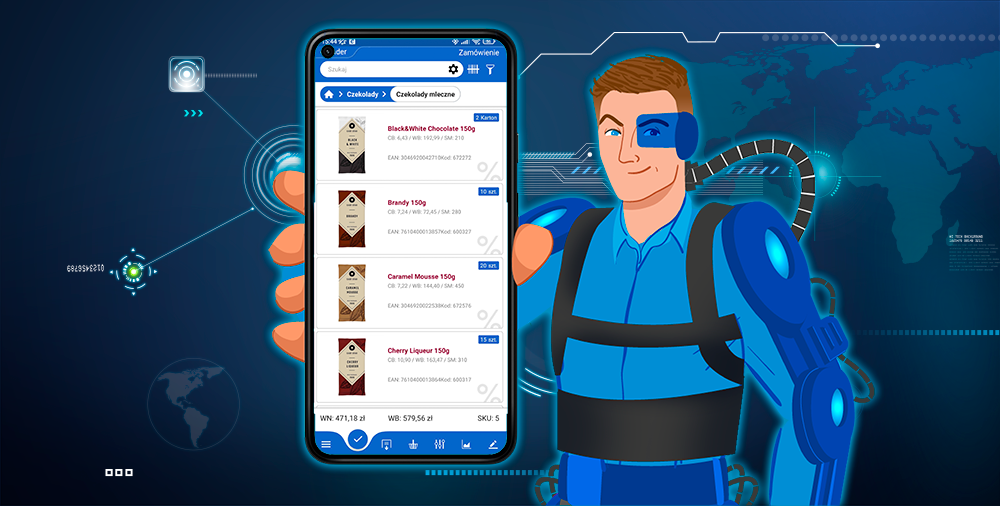


Over 50 criteria for selecting AI merchandising application [+BONUS]
Choosing an AI‑powered merchandising application is a tough call. Why do I say that? It’s not that companies choose badly—it’s that they can’t choose at all!

When preparing this article, my intention was not to recommend a particular in-store merchandising application. My goal is to help you make the right decision — one that will enable your teams to work comfortably, at an affordable price, and provide the security and data you need to grow your sales.
What does the world have to offer in terms of AI merchandising apps?
If you’re looking to boost the efficiency of your mobile workforce and speed up technological progress in sales, an AI-powered product recognition app should definitely be at the top of your list. The global market offers many shelf recognition solutions. Some of these have been around for over 10 years, while others were created yesterday. Underlying the general promise of value are various technologies, operating models, implementation models, user support models, hardware requirements and possibilities for cooperation between different systems.
If you are researching the image recognition market, you will see that providers include technology companies with experience of building SFA/mobile CRM systems. If you are looking for such a system, be sure to check out this article. Providers also include software companies, start-ups and global corporations.
I am aware that acquiring knowledge about AI-supported merchandising applications is similar to preparing for an exam; my expertise and understanding have been developed over a considerable period of time. However, if you’re interested in purchasing automatic audit technology, you need to quickly assess how useful the solutions are for your sales force and compare their functionalities. You don’t have years to learn or loads of money to burn.
NOTE: At the end of this text, you will find a spreadsheet for bidders to help you organise your criteria for selecting an AI merchandising application. This will enable your company to create a shortlist of suppliers to meet and discuss implementation offers with. If you don’t need to read the whole thing, go straight to the document.
What factors should be considered when choosing an automated merchandising application?
For many years, I have been observing the factors that influence our customers’ choice of application for automatic exposure testing. I analyse why they opt for eLeader solutions, when they choose competitors’ products and when they forgo any tool altogether. Conversations with customers have made me realise that many attractive marketing features are often not used during store visits. Ultimately, the key value that comes from audits is usually data. (By the way, if you believe in your data, I would like to shatter that belief.) Organised, scaled and reliable information is the most valuable outcome of projects involving fieldwork.
Automatic shelf scanning is not just about technology
So, let’s focus on how to obtain reliable data to ensure a successful project. It turns out that technology alone does not determine whether an image recognition project provides good data and a satisfactory ROI. What, then, should you look for if you want to learn about and compare automatic shelf audit systems?
Technology
All right, let’s start with technology. The technical aspects of AI merchandising applications are crucial for ensuring optimal performance, functionality, scalability and service quality. The choice of technology is closely related to the fieldwork model. Examples of the criteria that determine whether the proposed tool offers the required functionality include expecting results during a visit, analysing advanced indicators, product group size, price research, competition, the golden zone, the speed at which the AI model learns, offline recognition, BYOD, augmented reality and recognition quality. These are just some of the criteria that determine whether the proposed tool offers the functionality you require. Or functionality that you will ultimately not use, even though you will pay for it. Pay attention to how well-proven the offered technology is in comparable projects and ask how well it will serve your intended business scenario.
The supplier as a business partner
If you are looking for a stable solution, consider how long the organisation has been on the market, its customer portfolio, and its references. Assess its financial stability (e.g. using tools of this type) and its experience in your market sector. Ask about the roadmap and evaluate the potential supplier’s vision for developing the application.
Project economics
Transparent pricing, scalability, bundling and the ability to decide on the scope of the service make the project easy to budget for and secure. Check what you will be paying for (e.g. photos, visits, users, fixed or variable fees) and ensure that you and the management are comfortable with the costs.
Merchandising application and its integration capabilities
A common issue with IT solutions is their limited capacity for full integration into the IT ecosystem. Reports on availability or shelf share are clearly very valuable. However, data becomes even more powerful when it can be combined with sales data, the full structure of the sales force can be measured, and products can be categorised. In my opinion, solutions that work seamlessly with SFA/FFM, CRM and ERP should receive higher scores. Details such as APIs and single sign-on (SSO) can also indicate whether a provider is capable of handling demanding, sometimes transnational, corporate projects.
User experience
Working with the application on a daily basis requires a well-thought-out interface and workflow that avoids tedious and frustrating usability issues. Applications for sales representatives are primarily ‘workhorses’ that do not necessarily need to dazzle users with fancy features. A good interface should help users reach their goals as quickly as possible. Consider whether impressive visualisations genuinely accelerate onboarding, photo acquisition and data processing, or if they merely distract from shortcomings in other areas.
Availability and scalability
Sometimes, you may wish to oversee all field activities and manage all products, categories and KPIs from the outset of the project. However, at other times, you may only require a merchandising application to function within a specific channel, category or group of representatives (e.g. merchandisers or auditors). In certain situations, as well as taking photos, you may need to complete a survey or even place an order. Check which elements of the scenario a given application supports. Some providers allow you to perform all these tasks in a single merchandising application. Check whether the application offered can work with users who speak different languages. Ask about the hardware requirements of the proposed system and which mobile platforms it can be installed on.
Customer and user support
Visiting stores is still the responsibility of field teams. This means that as long as representatives have mobile devices for collecting data and performing tasks, they will require care, support, training, onboarding, a helpdesk, instructions, and communication. Ask your supplier how they can help your organisation to transition smoothly to the application. How will the offered system contribute to developing the competencies of 21st-century representatives, supported by artificial intelligence technology? Sometimes, ideas on how to use the huge volumes of data collected can dry up. In such situations, it is worth having a knowledgeable and experienced supplier on your side, who can help you develop analytical concepts, build reports and visualise data to improve your understanding of the market situation.
You should find this much simpler now
As I mentioned in the title of this article, I have identified over 50 important selection criteria for an automatic exposure analysis tool. If you have any other ideas, please write to me – I would be happy to discuss them. You don’t have to give equal weight to all of these criteria. However, I believe it is worth knowing them and being able to use them. For example, this could be useful when it is difficult to find differences between solutions that claim to have the same business value. Or simply when it is difficult to understand a supplier’s offer.
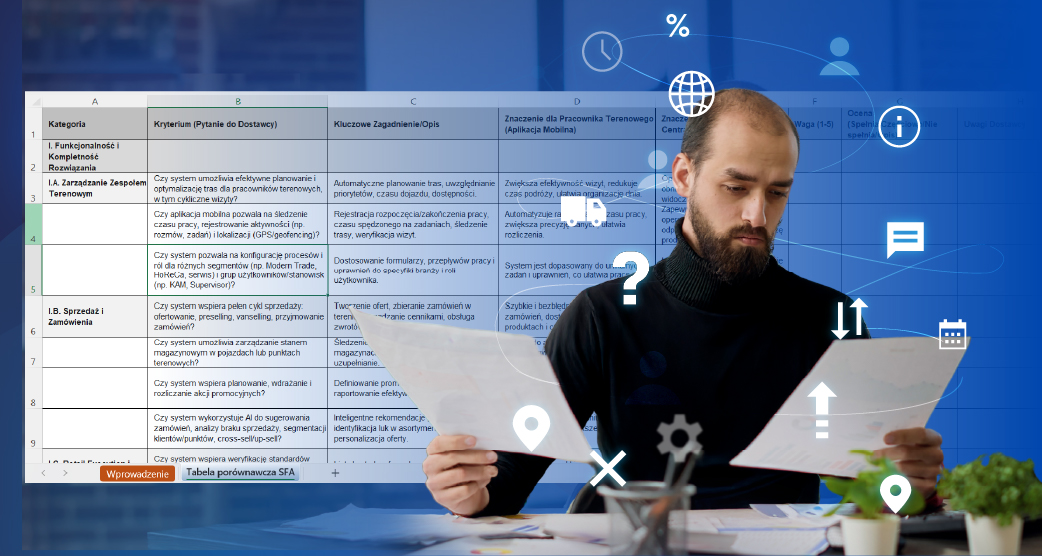
As I enjoy helping people and understanding why certain things happen or don’t happen, I have a gift for you. I have compiled all the relevant criteria for evaluating AI merchandising applications into a single, sectioned table. As well as the names of the issues, you will also find short descriptions of the criteria and their impact on fieldwork, back-office management, and value for management. If you like maths, you can assign a weight to each of these criteria and calculate the application’s score. I believe this tool will help you choose a provider and automated merchandising application to give your field teams a boost.
What is the next step?
After gathering information, create a shortlist of two to three bidders, then invite them for consultations and negotiations. Talk to them about how the application would be used in your field and do not settle for general answers. If necessary, test the solutions under the same conditions in the field. By taking a methodical approach, you will not only avoid purchasing an unsuitable solution, but also save months of work that would result in no solution being chosen. This can actually threaten the technological development of your organisation.
You can download a table containing over 50 criteria for selecting an AI merchandising application here:

Read also:
SFA Comparison: A Decision-Maker’s Guide [+BONUS]
A practical guide to choosing the right SFA/FFM system — plus a free comparison sheet to help evaluate sales support solutions. Time for Your Move Are you...